Over the last 30 years of investing and entrepreneurship, I’ve witnessed multiple technological transformations — but I’ve never seen a change nearly as impactful as the ongoing AI revolution.
My partner Craig Cummings and I have been investing in AI for many years. In fact, there are few investors who have not: almost all tech companies rely on artificial intelligence in some capacity.
However, we sensed a changing tide in 2019, when Alex Watson, one of our most trusted serial founders, approached us with the opportunity to invest in his new company. Gretel, he explained, would be building tools to enable “synthetic” datasets that would retain the properties of original data and allow businesses to train their own AI models on proprietary data with a heavy emphasis on privacy and security. We believed that high-quality synthetic AI training data would be as important for the 21st century as oil was in the 20th.
It wasn’t until 2021 that it became clear that the team at Gretel was spot on.
The advent of super-powerful commercially available LLMs and the rapid acceleration on the path towards AGI has transformed how we think about AI. Things that were very recently science fiction have now become an integral part of our daily lives, a driving force in our businesses. They are a defining trend for our future as a species. The AI revolution is reshaping our world, with its impact on future industries becoming increasingly evident.

Here’s how I see the current and future impact of AI applications, and the implications they have for global order and security. Our understanding of emerging AI technology is inseparable from how we evaluate extraordinary leadership when investing through Moonshots Capital.
Immediate Impact: AI’s Transformative Power Across Industries
Let’s start with the basics: every company, regardless of size or sector, should be leveraging AI to create efficiencies. AI applications are numerous, and AI has the potential to transform business operations across sectors. We’re not talking about replacing humans — in most cases we’re talking about augmenting them.
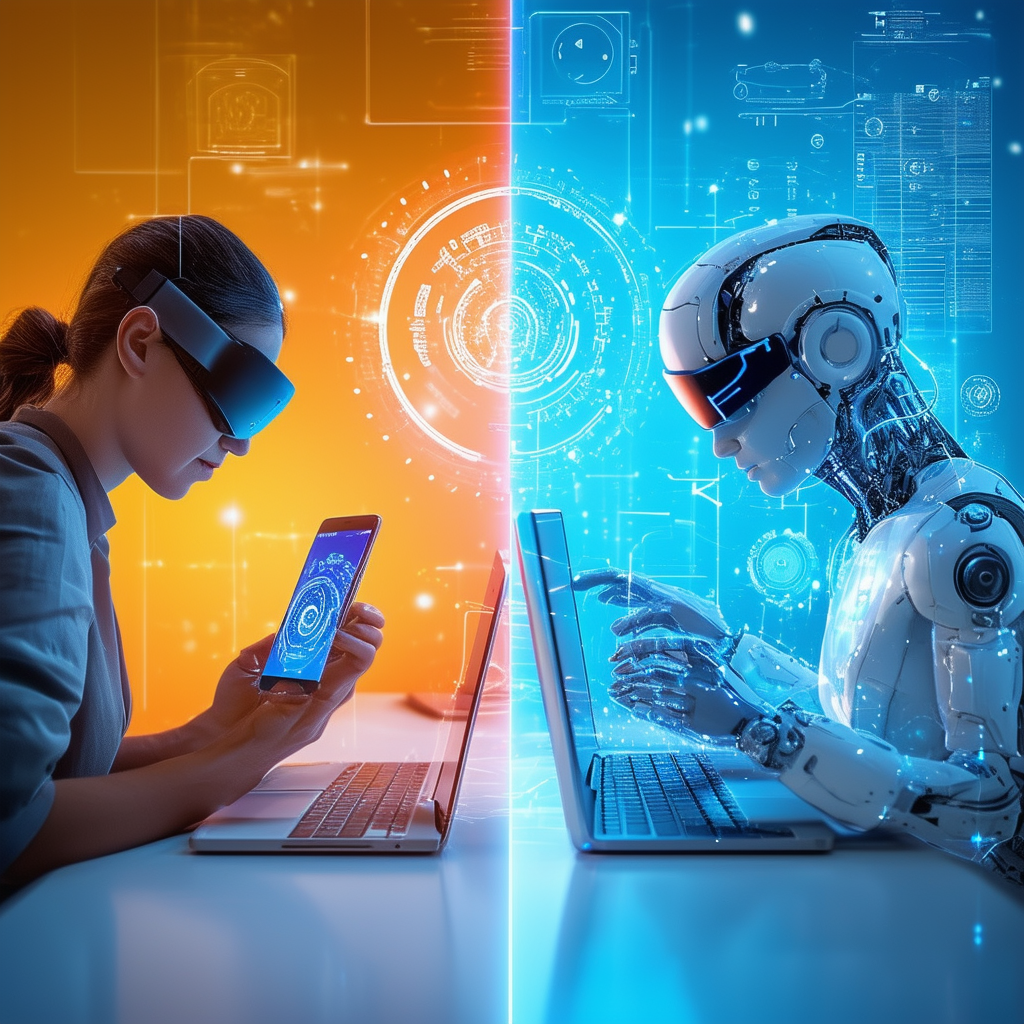
From customer service chatbots to software development and even healthcare, AI is already transforming how businesses operate. It gets even more interesting from there: we’re now seeing AI agents that can do outbound work. AI that can handle your sales prospecting or manage your social media engagement is already becoming a reality. The results so far have been mixed, but the potential is enormous.
Unsurprisingly, AI startup funding has skyrocketed to 35% of all venture capital investments in the U.S. this year. The sector has been almost single-handedly conquering the 2022 investing slump and continues to be on the rise. Granted, much of this growth is due to mega rounds raised by the likes of OpenAI and Anthropic, but we are still seeing many smaller companies showing great promise.
While it’s easy to get caught up in the gold rush, we try to keep our eyes on the prize: we are looking for technologies that are practical, solve real problems, have a clear path to revenue and scalability, and — most importantly — are run by extraordinary leaders.
Here are a few examples of applications that pique our interest:
Foundational technologies. Tools that allow other companies to build more and better — what I like to call “picks and shovels” — are our favorite kind of investments across the board. This is exactly why we invested in Gretel back in its early days, and the company’s synthetic data is now powering machine learning for developers across the world through partnerships with Google, Amazon, and Microsoft.
Nowadays, these deals tend to be too big for early-stage funds like Moonshots, and our flexible strategy of combining venture fund investing with syndicate vehicles has served us extremely well. For example, while not appropriate for our Seed Fund, we did run a syndicate and invested in xAI’s elite $6 billion Series B round.
Personalization at scale. AI-powered personalization that allows individuals and companies to have tailored user experiences will be in high demand. For example, MindStudio, one of the earliest syndicate investments we made back in 2016, allows users to build their own tailored bots on top of a plethora of commercially available LLMs. Serial founder & CEO Dmitry Shapiro even has a long-term ambition of using AI for “digitizing” the human mind. Take a look at his fascinating futuristic vision in this recording from our 2023 Extraordinary Leadership Summit.
Dual use and defense. Technology that supports U.S. national security is near and dear to our hearts. We are very excited about companies like Ghostdog, another Fund III investment, which leverages AI to help intelligence professionals gather, synthesize, and share information. We see many other valuable uses for AI in defense: autonomous systems, predictive maintenance for military equipment, and other technologies that serve the very country that made it possible to build and innovate better than anywhere else in the world.
Of course, as these AI applications in defense and dual use become more powerful and pervasive, they also raise important questions about privacy and security.
Privacy and Cybersecurity: Safeguarding the AI Frontier
As I already noted, the AI revolution depends on data — and the largest models need a lot of it. Unfortunately, the most valuable high-quality data is often the most sensitive. Unfortunately, the most valuable high-quality data is often the most sensitive: think medical records for AI-driven drug discovery, or proprietary business information for enterprise AI solutions. As AI security becomes more critical, ethical considerations in AI development must be at the forefront.
Companies like Gretel address this head-on through synthetic datasets that are mathematically proven to maintain privacy while being virtually indistinguishable from (and sometimes demonstrably better than) the original dataset. At our 2024 Extraordinary Leadership Summit, Co-founder & CEO Ali Golshan discussed the role of synthetic datasets in emerging AI. He believes that the real future of AI lies in targeted, domain-focused “small language models” as opposed to the currently available LLMs. He also dives into Gretel’s work with a range of partners, from Databricks to healthcare facilities — I highly recommend his talk to anyone interested in where AI infrastructure is going.
Although solutions like Gretel are indispensable for good actors who want to build their models responsibly and securely, it cannot stop bad actors from building “evil AI.” Unfortunately, the wide availability of advanced AI models has helped cybercriminals worldwide attack not just individuals, but companies and governments as well. Cyberattacks have not only increased in frequency but have also become disturbingly sophisticated and capable of deceiving even the most tech-savvy among us. Companies that deploy “good AI” to fight “evil AI” are urgently needed.
ID.me, one of the first investments in the Moonshots Capital portfolio, has years of experience and success combatting fraud. Co-founder & CEO Blake Hall briefly discussed these threats and the efforts to address them at our 2024 Summit. As a long-standing member of ID.me’s board, I have the privilege of “looking under the hood,” and I am heartened to see the effectiveness and inventiveness of the company’s AI-driven fraud prevention measures.
While AI-driven security measures are crucial, the looming threat of quantum computing adds another layer of complexity to cybersecurity. This is where companies like SandboxAQ come into play. Quantum computing — a critical technology we don’t talk about enough — is evolving alongside AI, and it poses a significant threat to current encryption methods. This is the kind of problem extraordinary leaders like serial entrepreneurs Jack Hidary and former Google CEO Eric Schmidt are thinking about. SandboxAQ, their new company, is working on replacing current public-key cryptography algorithms with quantum-resistant ones, preparing us for a post-quantum world. This isn’t just a tech issue — it’s a matter of national security, with the U.S. government flagging quantum computing as a key technology for this reason.
I believe that the future of AI security lies in the synergies between innovative companies tackling different aspects of the challenge. Gretel’s synthetic data capabilities, ID.me’s advanced identity verification, and SandboxAQ’s quantum-resistant cryptography form a multi-layered approach to AI security. This ecosystem enables the development of robust AI models with verified users, all protected against future quantum threats. As investors, we see immense potential in companies that not only excel in their niche but also contribute to this broader, more secure AI landscape, shaping a future where AI can be leveraged safely and effectively across all sectors.
Hardtech: AI’s Tangible Future
Now back to the fun stuff: humanoid robots and self-driving cars.
AI is a complete game-changer for hardtech. Its implementation in the physical environment is the main reason our lives will look unrecognizable in 10 years, and the economic impact of these technologies will be staggering.
Autonomous vehicles are the most prominent example of this trend. Companies like Tesla are pushing the boundaries of what’s possible, using AI to interpret complex road conditions and make split-second decisions much more accurately and quickly than any human ever could. Waymo and Cruise are taking their self-driving cars out for a spin, too.
AI robotics is another area where industries will be seeing major transformations. Brett Adcock’s Figure, powered by OpenAI’s technology, is developing humanoid robots that can perform complex tasks with unprecedented dexterity and adaptability. These robots have the potential to transform manufacturing, healthcare, and even space exploration.
As for Moonshots, dual-use and defense implementations get us very excited and allow us bring our full network to assist the founder. Proteus Space is on a mission to help the United States build custom small satellites faster and better to win the new Space Race against China. Its superpower is MERCURY, an AI-assisted autonomous digital engineering tool that can digitally design, build, and test payload-tailored, custom satellite buses. This technology significantly reduces development time and costs, giving the U.S. a crucial edge in rapidly deploying advanced satellite systems.
Meanwhile, Red 6 is incorporating cutting-edge AI directly into the hardware it is building. Its augmented reality fighter pilot training helmets rely on AI to respond to the wearer’s actions in real time, emulating dogfights and refueling maneuvers at breakneck speed and in an outdoor environment. Ultimately, this kind of technology will pave the way for pilots and AI to work in synergy to deploy unmanned aerial vehicles (UAVs) securely and responsibly, without risking human lives.
Jason Dunn and his team at Outpost Space are building an earth return satellite capability while also manufacturing optic fiber in zero gravity. The system uses AI and robotics to deliver the satellite payload back to earth to any 5 x 5 meter landing zone on the planet and the space-manufactured optic fiber is critical to the development of AI capabilities in and between data centers. Both capabilities have obvious dual use applications.
Of course, with great power comes great responsibility. As AI becomes more embedded in critical systems, issues of safety, reliability, and ethics become paramount. These concerns intersect with the privacy and security challenges we discussed earlier, particularly in areas like autonomous vehicles and defense applications. Companies that can navigate these complex issues while pushing the boundaries of innovation will be the true leaders in this space.
For visionary leaders who can tackle these challenges head-on, the opportunities in AI-powered hardtech are truly extraordinary. At Moonshots, we’re committed to backing these leaders and helping them shape a future where AI enhances our capabilities and improves our lives in tangible, meaningful ways.
The Double-Edged Sword: AI’s Impact on Democracy and Global Security
Even as we marvel at AI’s potential to transform industries, we must also grapple with its profound implications for democracy, national security, and global stability. The same technologies that promise unprecedented efficiencies and innovations also pose significant challenges.

Misinformation and democracy are at the forefront of these concerns. AI-powered tools can generate and spread false information at an alarming rate, potentially swaying public opinion and undermining the foundations of democracy. At the same time, AI models fine-tuned to conform to specific ideologies can distort our understanding of the world. Their bias is not always as glaringly obvious as Gemini’s images of female Founding Fathers and can therefore go completely unnoticed by unsuspecting users. The challenge of AI misinformation could decide the fate of democracy in the digital age.
Although SpaceX and Tesla get the most media coverage of all Elon’s projects, I believe that “TruthGPT” — the ideal that underlies the development of xAI and Grok — might be his most important one. TruthGPT will be the maximum truth-seeking AI, built to rely strictly on actual facts and reality in order to understand the nature of the universe. Most importantly, Elon believes that AI that cares about understanding the universe will be less likely to turn against us. I believe that Elon can succeed in this project — after all, he has proved multiple times that he can do the “impossible.”
While Elon’s TruthGPT project aims to address long-term concerns about malevolent AGI and truth-seeking, we already face more immediate AI-driven threats to national security that demand our urgent attention. The race for AI supremacy, particularly between the U.S. and China, has far-reaching influence on global economic and political trends. Our current infrastructure and systems are woefully unprepared for potential AI-driven threats. Any direct confrontation could result in massive losses across our digital infrastructure, financial systems, and beyond. The speed of AI development far outpaces our ability to regulate it effectively, creating a dangerous gap in our defenses.
However, I believe that American innovation will prevail: We constantly see defense technologies that can revolutionize military capabilities, from autonomous systems to advanced threat detections. We are certain to add some of them to our portfolio.
Our government is ill-equipped to handle the breakneck pace of innovation, and we need to do more. Although AI policy should be an urgent bipartisan priority, we have yet to see constructive regulation on the horizon. This is unsurprising, as even people on the cutting edge of technological development can’t come to an agreement on the best way to proceed. In an ideal world, we would be keeping some of America’s greatest AI advancements under a tight lid, but this is no longer possible. Innovation refuses to stay in a box — and that means our adversaries have access to it almost as soon as we do. Unfortunately, it seems the only thing regulation could do by the time it arrives is slow us down in the race with China.
Ultimately, navigating these challenges requires visionary leadership that balances innovation with responsibility. I believe that the American startup ecosystem has this kind of leadership in abundance. As investors, we must back people who understand the profound implications of the technologies they’re developing and are committed to shaping a future where AI enhances rather than undermines our democratic values and national security.
The stakes are high, and we are only beginning to understand the long-term impact of AI on society. However, I believe that the potential for positive change outweighs risks, and that moonshot thinking will prevail in bringing a better future.
Embracing the Next Evolution
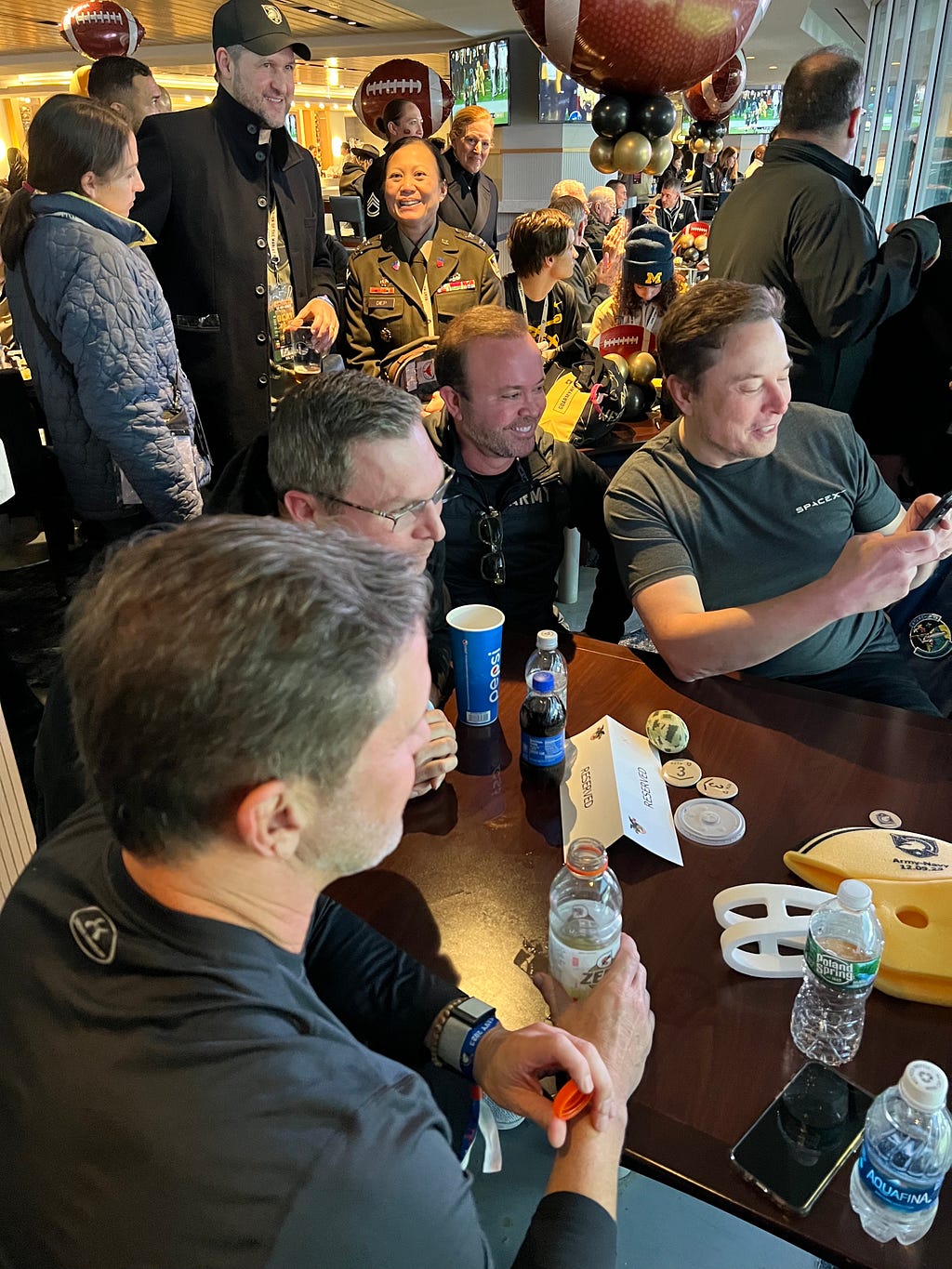
At last year’s Army-Navy game, I watched Elon Musk and my friend Blake Hall step onto the field to the raucous cheers of cadets and midshipmen. It was a perfect and heartening image of American innovation meeting service: two visionary entrepreneurs coming together with those who defend democracy with their lives.
These were the people keeping us safe in the present while building the future our children will inherit. And later, when I dived deep into conversation with Elon and Blake, I was even more assured of the fact that, for all its divisions, our country still has the extraordinary leadership it needs to continue changing the world for the better.
My wife’s and my twins, Grant and Grace, are fourteen years old now and AI is already making its way into their lives as they use it to learn and play, heralding a new era of human potential. Their’s will be the first generation whose abilities will be augmented by AI, and who will be able solve challenges we previously believed insurmountable. They may even transcend humanity itself: with Neuralink, we’re already seeing the early stages of humans merging with technology, and augmenting our cognitive capabilities by incorporating AI into our brains strikes me as the logical next step.
Whether or not this future materializes depends on the choices we make now. Many fear this progress, but I see it as an inevitable and exciting frontier. As investors and leaders, we must show willingness to invest in moonshot ideas, to support leaders who combine technological vision with ethical foresight, and to encourage innovation while safeguarding our values.
At Moonshots Capital, we’re committed to backing these visionaries. We believe that extraordinary leaders — many forged in military service or tempered by entrepreneurial challenges — are uniquely equipped to navigate the complex landscape ahead. They embody the same spirit of service and innovation I saw in those young cadets and midshipmen, eager to shape the future.
The path forward won’t be easy. It will require courage, vision, and an unwavering commitment to our shared humanity. But as I watched the next generation of military leaders cheer for innovation and progress at that Army-Navy game last year, I was filled with hope. If we can harness that energy, that optimism, and that sense of service, there are no limits to what we can achieve.
For Grant, Grace, and all the children of their generation, we owe it to them to dream big, invest wisely, and lead with integrity. The future is calling, and it’s time for us to answer.
Moonshots Capital is a military veteran-founded venture capital firm that invests in early-stage startups with extraordinary leaders.
Subscribe to our newsletter for monthly updates about new investments, portfolio milestones, opportunities, and market commentary.
You can also follow Moonshots Capital and its General Partners on social media:
Moonshots Capital Twitter, LinkedIn
Kelly Perdew Twitter, LinkedIn
Craig Cummings Twitter, LinkedIn
Stopping Cancer: Why We Invested in Vironexis was originally published in Leadership Prevails on Medium, where people are continuing the conversation by highlighting and responding to this story.