I first met Rob Leathern back in early 2005, when I was advising LinkedIn in its earliest days. The platform was wrestling with a question that has only gotten bigger since: how do you build something people can actually trust, when there are smart, motivated adversaries working to exploit it? Rob was already thinking about that problem more seriously than just about anyone I’d met. We stayed in touch for the next twenty years as he went on to hold some of the most consequential roles in platform integrity anywhere in tech. Over those years, I was circling the same problem: I’ve written before about why companies deploying “good AI” to fight “evil AI” would become urgently needed, and why securing the digital world is one of the defining challenges of this era. So, when Rob called me about InfoHawk, it felt like the conversation we’d both been building toward for twenty years.
The Economics of Deception Have Collapsed
Deception used to have a cost structure. Cloning a bank’s website, faking an executive on video, spinning up thousands of synthetic identities all took real skill, time, and money. An attacker can now run coordinated, adaptive campaigns across platforms at machine speed, for almost nothing. The numbers are staggering: consumers lost an estimated $442 billion to scams last year, and 71% of U.S. companies reported more AI-powered fraud attempts in 2025 than the year before.1
Meanwhile, the defenders are bringing a knife to a drone fight. Most enterprise fraud systems were built for a slower era, relying on brittle rules, channel-by-channel silos, and manual review queues that can’t scale against automation. Worse, they mostly measure takedowns, which tells you what you caught, not what slipped past. Plenty of organizations genuinely can’t tell whether they’re winning or just running in place.
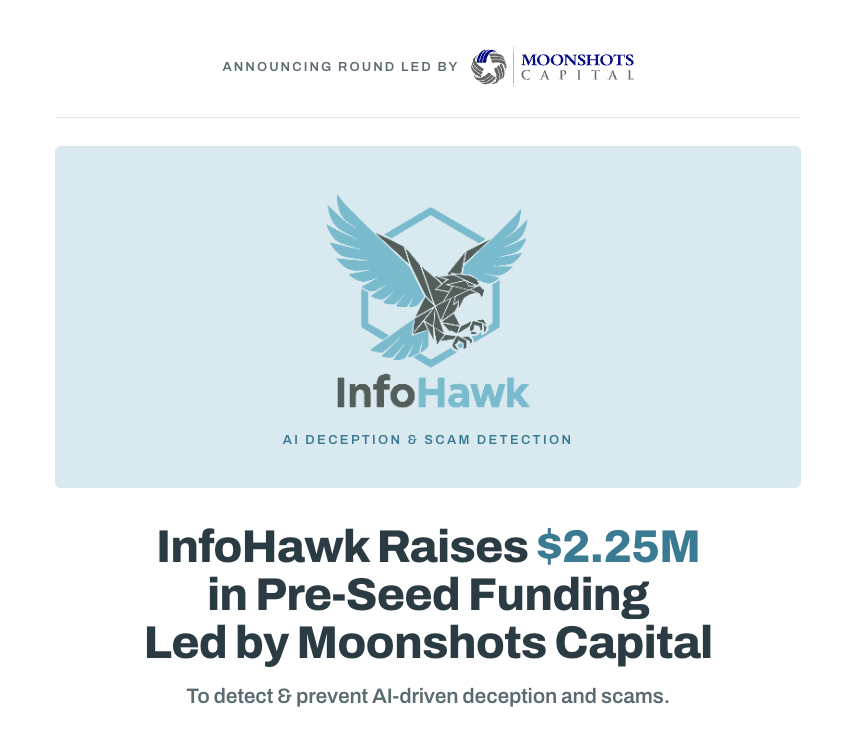
InfoHawk Raises $2.25M in Pre-Seed Funding led by Moonshots Capital, with investors in this round including former two-term Chairman of the Federal Trade Commission, Jon Leibowitz, as well as Brian O’Kelley (founder of AppNexus), Rob Goldman (former head of Ads at Meta), James Walker (founder and CEO of Centigrade), Scott Spencer (former VP of ads safety and privacy at Google), Vlad Fedorov (CTO of GitHub) and Nikila Srinivasan (former VP of Product at WhatsApp/Meta).
Mapping the Network, Not the Noise
What I love about InfoHawk’s approach is that it’s foundational. The founding insight is that fraud runs on a supply chain. Everyone else inspects the individual ad, email, or post, the visible product on the shelf, and makes a binary call. But attackers restock that shelf endlessly using the same supply chain underneath: the hosting clusters, payment rails, domain patterns, and operational fingerprints that quietly tie a thousand “unrelated” scams back to one operator.
Twenty Years of Earned Credibility
Our thesis hasn’t changed since Craig Cummings and I started this firm: we invest in extraordinary leadership. Alongside Rob, Ben Poiesz spent nearly a decade at Google as an early product leader on Android before running cloud and AI infrastructure at Grammarly. Jamie McCrindle brings 20-plus years of engineering, including a stretch at Meta on fake-account prevention, one of the most adversarial problems in the entire field. Jamie and Rob have shipped together before, and that kind of pre-existing trust is very difficult to find.
Experience like this can’t be manufactured. It shows up in warm, senior-level relationships with the Trust and Safety, Risk, and Integrity leaders at the exact platforms InfoHawk wants as customers, earned over career lifecycles. Rob hosts many of these leaders on his podcast, Won’t Fix, offering a window into the conversations happening at the highest levels of platform integrity. To get deeper insight into what InfoHawk is building, watch Rob’s presentation at our 2026 Annual General Meeting in Austin, Texas.
Core To the Moonshots Capital Thesis
We’ve spent years backing the companies securing the AI frontier: ID.me on identity and fraud, Gretel on privacy-preserving synthetic data, and SandboxAQ on quantum-resistant cryptography. InfoHawk adds a crucial new layer, a cross-platform, real-time intelligence engine aimed squarely at deception itself.
Moonshots Capital led InfoHawk’s $2.25 million pre-seed round, joined by an exceptional group of angels who have built, defended, and regulated platforms at scale, including former two-term FTC Chairman Jon Leibowitz, AppNexus founder Brian O’Kelley, former Meta Ads head Rob Goldman, and GitHub CTO Vlad Fedorov.
For years, Rob, Ben, and Jamie were the reason the biggest platforms didn’t lose the fraud war outright. Now they’re offering that same defense to everyone else, right as the attackers got their hands on the most powerful tools in history. I’ve had twenty years to form a view on whether this is the right team to bet on.
It is.


